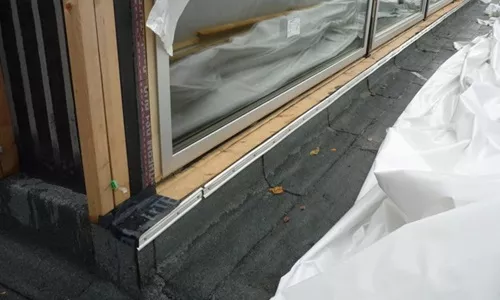

FOAMGLAS® for flat roofs in wood construction
Wood Meets Cellular Glass
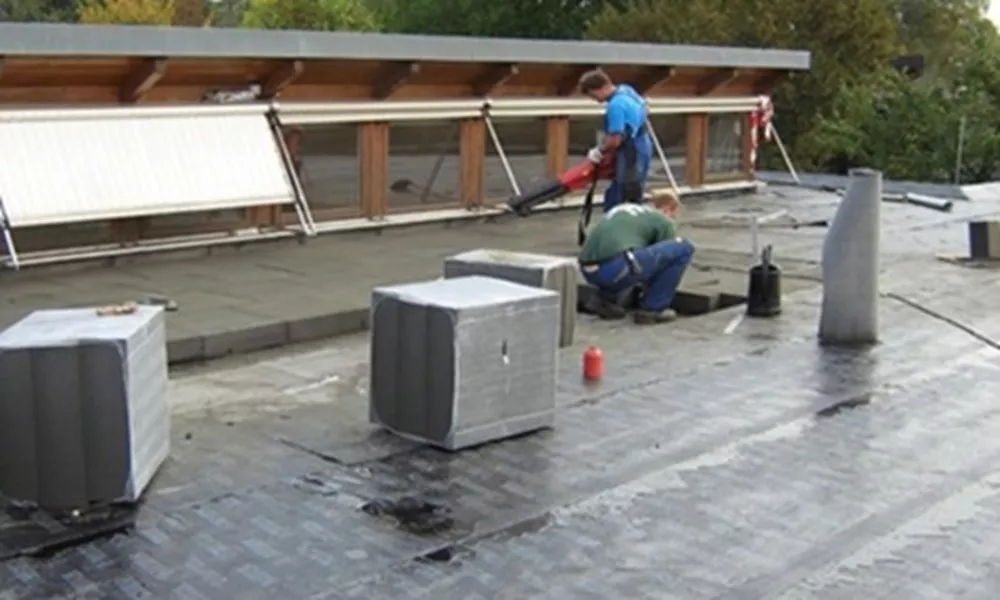
Flat roofs in timber construction embody modern building design. They combine an organic aesthetic with functionality and durability. However, in the field of timber construction, flat roofs present specific challenges for designers and building owners: protection against moisture, fire protection, and sustainable thermal insulation must be ensured. Thanks to its specific properties, FOAMGLAS® cellular glass offers the ideal insulation solution here.
For flat roofs, FOAMGLAS® offers a safe and sustainable solution. Made of cellular glass, it has high compressive strength and is both waterproof and vapor-tight. Its insulation performance starts at 0.037 watts per meter-kelvin (calculated value) for a compressive strength of 160 kilopascals (calculated value, without deformation). Furthermore, this insulation material is extremely durable and provides a dimensionally stable support for the waterproofing. By positioning the insulation above the wooden framing, the framing remains fully exposed to the warm, dry indoor climate. This minimizes the risk of condensation formation and protects the framing in the long term. At the same time, FOAMGLAS® prevents moisture penetration, even in the event of a leak—a decisive advantage for extending the service life of wooden structures.
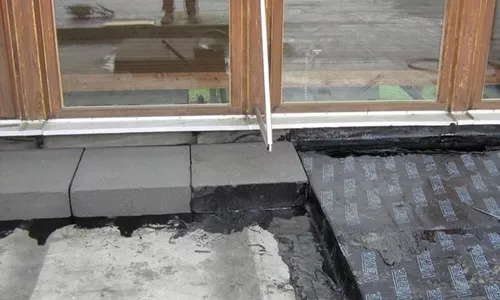
structure in timber construction
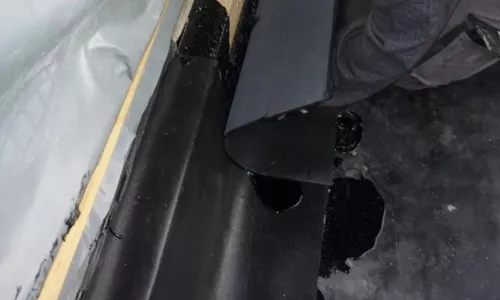
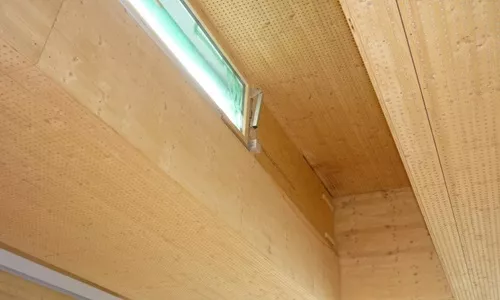
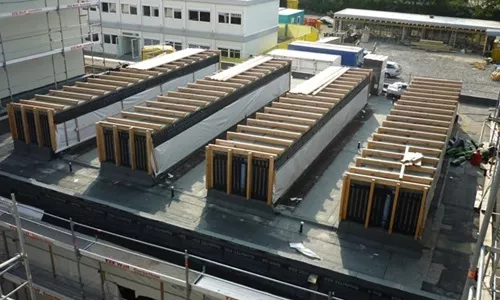
The wooden roof structure, which can be made of glued laminated timber, solid wood, or cross-laminated timber, forms the basis of the roof. It provides the load-bearing function and must be permanently protected against moisture. A separation layer is installed over the wooden roof structure. This serves as a temporary waterproofing and allows the wooden roof structure to expand and contract in response to changes in humidity.
👉 See compact roof systems
The separation layer, made of bituminous membranes, is installed invisibly, and the joints are sealed. Cellular glass is then laid over this separation layer to provide insulation. Bonding is possible using either hot bitumen or cold adhesive. To achieve continuous insulation without thermal bridges, the insulation panels are installed across the entire surface with filled and staggered joints. This results in a compact, vapor-tight insulation layer into which water cannot penetrate.
👉 Discover roof applications in timber construction.
Above this is typically a two-layer bituminous waterproofing membrane. This protects the roof from water infiltration and forms the weather-resistant outer layer of the roof structure. It is bonded over the entire surface of the compact insulation assembly, thereby preventing water from spreading in the event of damage.
use and planning
With FOAMGLAS®, you can realize virtually any intended use for your roof. Whether you’re planning a roof terrace, a retention roof, extensive or intensive green roofing, spaces for technical equipment, or a photovoltaic system, this non-deformable and dimensionally stable insulation material allows you to achieve all these applications with a single structure.
👉 Explore active roof solutions.
👉 See also a practical example:
Extensive green roof on timber structure
Intensive green roof on timber structure
Whether in planning or application, you remain flexible and can generally install your equipment and fit out your roof without complex substructures and with minimal penetrations.
at the highest level
While wood offers many advantages as a building material, it also imposes high requirements for fire protection. FOAMGLAS® perfectly meets these requirements: this insulation is classified as non-combustible (Euroclass A1) and therefore does not increase the fire load. Unlike many other insulation materials, cellular glass does not emit smoke or toxic gases in the event of a fire. This facilitates rescue operations.
The tight installation of this vapor-tight insulation material prevents the spread of combustion gases and deprives the fire of the air needed for combustion from the insulation. Even during intensive firefighting operations, the insulation layer does not become saturated with water. This relieves the load on the building structure. The insulation material thus makes a decisive contribution to the safety of buildings and their occupants.
A contribution to the circular economy
FOAMGLAS® is a solution that is both functional and energy-efficient. Furthermore, this insulation material uses glass cullet as a raw material, combined with new glass. Thanks to its extreme longevity—as indicated in the Environmental Product Declarations (EPDs) with a lifespan of up to 100 years (in accordance with EPD-PCE-20200300-IBB1-EN, published by the IBU)—the material retains its original properties across generations.
*With a lifespan of up to 100 years (according to the environmental declaration EPD-PCE-20200300-IBB1-EN, published by the IBU), FOAMGLAS® retains its technical properties across generations.