

Why hospital green roof designs succeed or fail
Designing hospital green roof insulation for resilience and long‑term performance
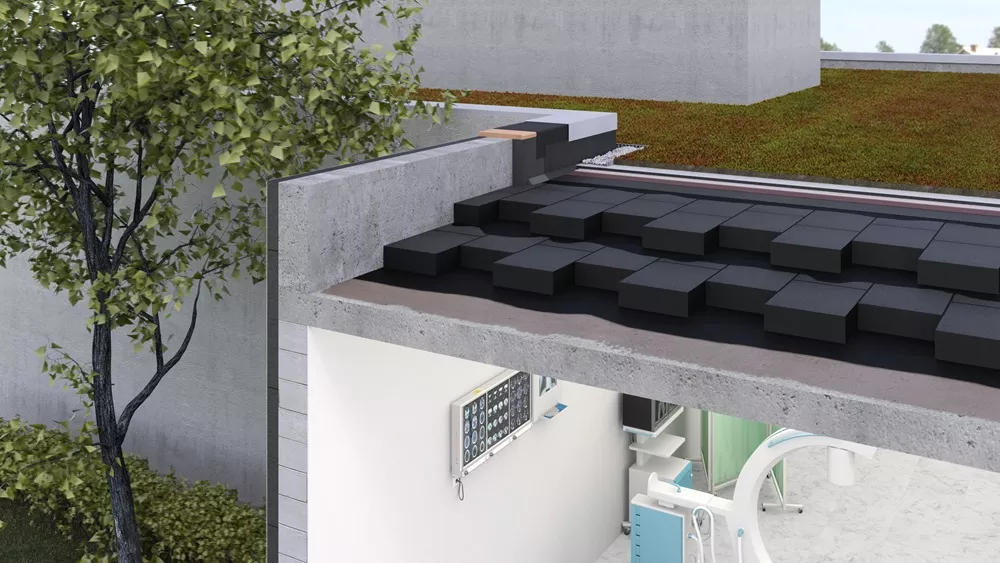
Hospitals are among the most demanding building types to design. Continuous operation, strict safety regulations and long service lives mean every construction decision must prioritise reliability.
At the same time, these projects are under increasing pressure to address climate resilience targets, manage stormwater and improve patient wellbeing. Within constrained urban sites, green roofs are often proposed as a way to meet these demands, offering benefits such as rainwater attenuation, urban heat reduction and improved microclimates.
The success of hospital green roofs depends largely on the underlying roof build-up. Poorly detailed assemblies can introduce technical risk into buildings that cannot tolerate failure.
The Regulatory Framework is accelerating the adoption of vegetated roofs across Europe. The EU Green Deal, urban heat-mitigation strategies and sustainability standards such as BREEAM all encourage measures that manage rainfall, reduce surface temperatures and support biodiversity.
A growing body of research reinforces this. A 2022 study led by O’Hara et al., published in the Frontiers in Sustainable Cities, highlights how green roofs can contribute to improved urban microclimates, stormwater management and broader environmental resilience in healthcare settings.1
Further research summarised by ClimaHealth draws on the same body of work, noting that access to green space in hospitals can support patient wellbeing and staff experience by improving the quality of the built environment.2
Additional peer-reviewed research also highlights the role of green roofs in reducing heat transfer and managing rainfall, supporting energy efficiency and climate adaptation in healthcare infrastructure.3
These findings align closely with the priorities of hospital estates teams. Healthcare facilities require infrastructure that supports long-term resilience while maintaining safe, controlled internal environments.
Hospitals operate under very different conditions from commercial buildings. A roof leak that may be manageable elsewhere can quickly become a critical issue in a healthcare environment.
Design teams therefore must focus on several key areas at specification stage:
- Moisture risk and waterproofing reliability
Green roofs retain water and growing media above the waterproofing layer. Persistent moisture exposure places continuous demands on both waterproofing systems and insulation. - Structural load and safety margins
Vegetation, soil, retained water, and maintenance access all contribute to roof loading. Structural design must account for both permanent and variable loads in line with Eurocode principles. Fire safety and material selection
Hospitals require robust fire-safety strategies. Material selection within the roof assembly plays a key role in limiting risks.- Root penetration and durability
Root systems can gradually compromise waterproofing layers if protection is not designed correctly. - Drainage and climate resilience
Rainfall intensity is increasing across many European regions. Green roofs must therefore incorporate reliable drainage and water management strategies to cope with future conditions.
Each of these considerations reinforces a central principle: long-term performance depends on the integrity of the entire roof build-up.
Insulation beneath green roofs does much more than offer a thermal function. It contributes directly to the structural stability and moisture behaviour of the roofing system.
Materials that compress under permanent load can disrupt drainage layers and alter roof geometry over time. Moisture-sensitive insulation may lose thermal performance or degrade when exposed to persistent damp conditions.
Cellular glass insulation is often specified in these applications because it remains dimensionally stable under load and is resistant to water and vapour. FOAMGLAS® cellular glass insulation, for example, has been used in several intensive roof systems where structural reliability and moisture resistance are critical.
Hospitals are designed for service lives measured in decades. Roof systems must therefore perform consistently under sustained environmental exposure.
Architects and engineers increasingly approach green roofs as engineered assemblies rather than landscape features. Careful attention to load distribution, waterproofing protection, root resistance and drainage capacity at the design stage reduces long-term risk.
Green roofs can support climate resilience and patient wellbeing when these technical fundamentals are addressed.
For project-specific advice on roof build-ups and load-resistant insulation systems, contact the FOAMGLAS® technical team.
1 O’Hara, A.C. et al. (2022). The Sustainable Prescription: Benefits of Green Roof Implementation for Urban Hospitals. Frontiers in Sustainable Cities.
2 ClimaHealth (2022). The Sustainable Prescription: Benefits of Green Roof Implementation for Urban Hospitals.
3 Vallée, A. (2024 Green hospitals face climate change: Between sobriety and resilience. PubMed Central (NCBI)