

Compact roofs: load, moisture and risk
Urban school design
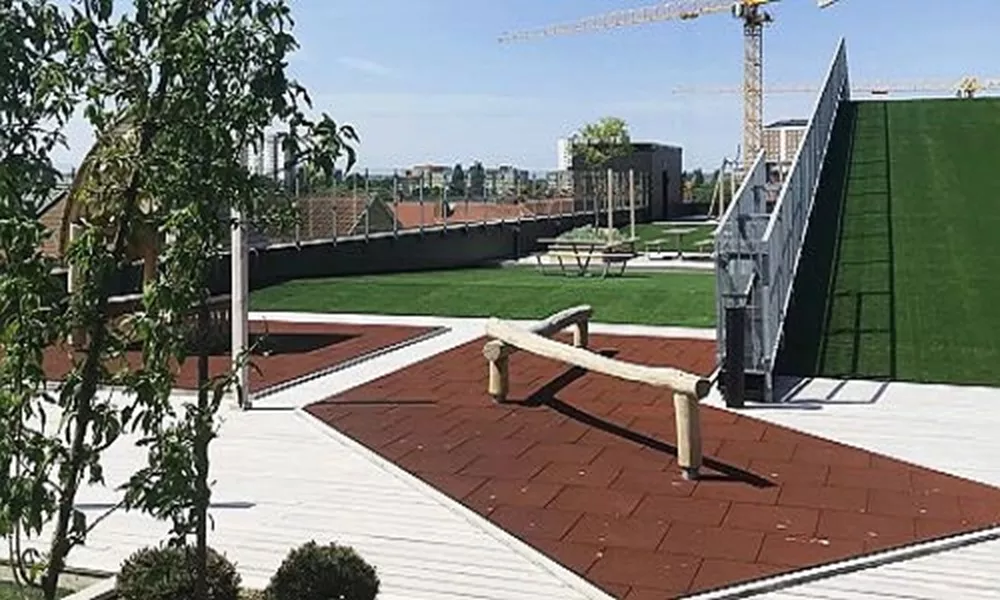
Space comes at a premium in most cities. Limited land availability and growing populations are forcing designers to rethink how educational buildings function, down to the last square metre.
An increasingly common remedy for this problem is the active roof. Builders now construct school playgrounds, sports areas, and learning terraces above the classroom rather than beside it.
A once ordinary roof becomes a useful and stimulating space. It shifts from a passive component to a dynamic, safety-critical element of the building.
Urban schools often face severe spatial constraints and expansion at ground level is rarely possible. Rooftops are therefore being used to provide essential outdoor space for students
In Malmö, Sweden, the Molnets Förskola preschool created a 2,850 m2 schoolyard on the roof of an existing building, allowing much needed outdoor play space for this city-based school.
Streamlined roofing systems allow architects to convert unused areas into safe, secure spaces for long-term use.
The technical requirements of a playground roof differ significantly from those of a conventional rooftop.
Architects and designers must address several critical factors:
-
High and permanent loads
Playgrounds introduce constant structural loads from paving, equipment, soil, and frequent use. Roof assemblies must remain stable under these conditions for decades. -
Moisture protection and durability
Roofs are exposed to rainfall, snow and seasonal temperature changes. Waterproofing layers and insulation must perform reliably despite heavy use above. -
Fire safety in public buildings
Educational facilities require stringent fire-safety strategies. Materials must therefore support the overall safety approach. -
Difficult maintenance access
Once a rooftop playground is installed, accessing underlying roof layers becomes complex and costly. Long-term durability is essential.
These constraints explain why many specifiers adopt compact roof designs for active roofs.
Compact roofs differ from traditional flat roof assemblies in one key respect: the insulation layer is bonded directly to the structural deck and waterproofing layer. The resulting build-up behaves as a unified system.
This approach supports dimensional stability under load and reduces the risk of moisture migration within the roof layers.
Cellular glass insulation is commonly used in compact roof designs because it does not absorb water and maintains structural stability under pressure. FOAMGLAS® cellular glass insulation has been applied in several European projects where rooftops support public use, including schools, art centres and university facilities.
The Malmö preschool project illustrates this principle. Designers selected FOAMGLAS® insulation because of its load resistance, moisture impermeability and non-combustible characteristics, helping create a stable and safe rooftop play environment.
Successful projects begin with careful design intent. Structural capacity, moisture protection and fire safety must be considered together and integrated into the roof build-up from the earliest stages.
Rooftop playgrounds and green roofs demonstrate how architecture can respond creatively to urban constraints. A well-designed compact roof allows these spaces to remain dependable and fit for purpose for the generations of students who will use them.
For deeper guidance on compact roof assemblies and load-resistant insulation systems, contact the FOAMGLAS® technical team.
In need of an expert advice?
Get in touch!