

How to specify FM-approved roof systems to meet insurer requirements
Designing roof systems that perform under fire, wind, hail, and water exposure
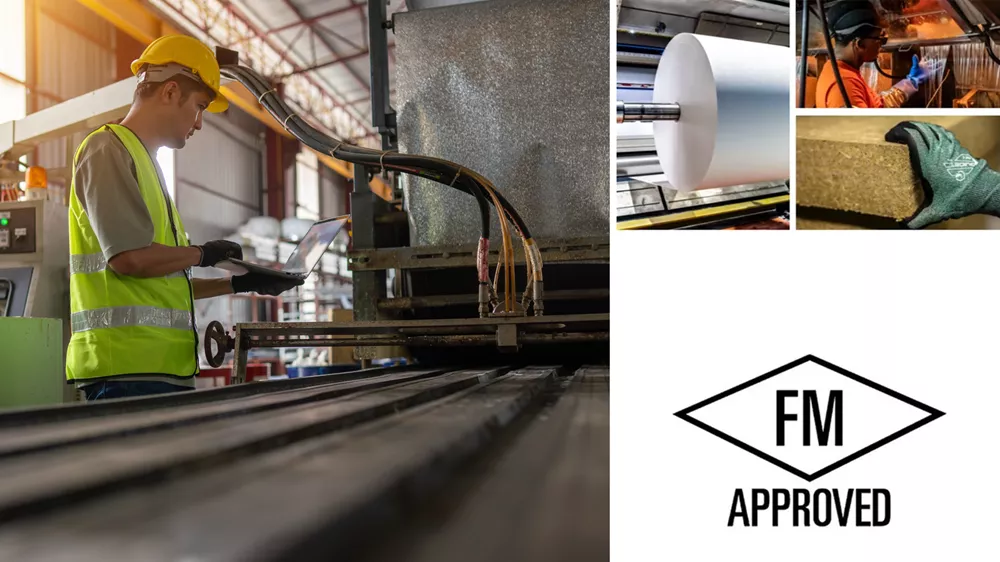
FM Approvals is increasingly shaping how non-residential roofs are designed. In high-value and mission-critical buildings, it is often not just a preference, but an insurer requirement.
FM Global, one of the world’s leading industrial insurers, sets performance standards focused on loss prevention. FM Approvals operates as its independent testing and certification body, validating whether products and assemblies meet these requirements under real-world conditions.
For buildings such as data centres, logistic hubs and industrial facilities, this distinction matters. Roof failure in these environments can lead to significant property loss and business interruption. FM Approvals addresses this risk by focusing on how complete roof systems perform under fire, wind, hail and water exposure.
For specifiers, this shifts responsibility upstream. Compliance depends on designing and documenting a roof assembly that matches a tested and approved configuration.
Product approval
is not system approval
A common source of risk is the misunderstanding between product approval and system approval.
A material may be FM Approved as an individual component, such as insulation or membrane. However, this does not necessarily mean it can replace a similar FM approved product in any FM-approved roof system. Approval only applies when that product forms part of a complete assembly that has been tested and listed as a system.
Substituting components or altering the build-up will invalidate approval. This creates a disconnect between specified assembly and insurer expectations, which may only become apparent during project review after a loss event.
Specifying assemblies rather than components reduces this uncertainty. Verified listings, such as those available through RoofNav, provide a clear reference for compliant system design.
Fire performance
is about system behaviour
FM Approvals evaluates roof performance under external fire exposure. This goes beyond reaction-to-fire classifications and focuses on how the full assembly behaves during a fire event.
This distinction is particularly important in mission-critical buildings where limiting fire spread and protecting structural integrity are key priorities.
Non-combustible insulation, combined with appropriate system layering, can support more robust fire performance when incorporated into a tested assembly. FM classifications such as Class A reflect this system-level behaviour under defined test conditions.
Wind uplift and hail
are primary failure drivers
Extreme weather remains one of the most common causes of roof failure in industrial and commercial buildings.
FM testing includes wind uplift and hail resistance, providing verified performance thresholds for complete assemblies. Ratings such as 1-480 for wind uplift and Class 1-SH for severe hail indicate that the system has been tested to withstand significant environmental stress.
These classifications are based on physical testing rather than theoretical modelling. Aligning roof design with these ratings early in the specification process helps avoid redesign, delays, and approval challenges later.
Water ingress
drives secondary damage
Water penetration following a roof failure often causes more disruption than the initial event.
After fire exposure, hail impact, or mechanical damage, moisture can enter the roof build-up and migrate laterally. In many systems, this leads to widespread saturation, making it difficult to assess damage, increasing the scope of repair.
Controlling water and vapour movement within the assembly can limit this effect. Insulation materials that are impermeable to water help contain damage locally, supporting faster diagnostics and more targeted intervention.
This has direct implications for downtime and business continuity in operational facilities.
Compliance
must be verifiable
FM-approved roof systems must be traceable and documented. Insurers and project stakeholders increasingly expect clear evidence that the specified assembly matches an approved configuration.
Tools such as RoofNav allow specifiers to verify that the complete build-up, (including deck, vapour control layer, insulation, and waterproofing) aligns with FM-approved listings.
Installation must follow the tested specification. Deviations in materials or detailing can compromise approval, even where individual components remain compliant.
A typical example is the FOAMGLAS® and SOPREMA roof assembly listed in RoofNav (Assembly Number: 583529-419229-0).
This assembly has been tested for fire exposure, wind uplift, hail resistance, water performance, 1-480 wind uplift resistance and Class 1-SH severe hail rating, demonstrating how system-level testing defines performance outcomes.
Designing
for loss prevention
FM Approvals is part of a loss-prevention driven system by FM Global. It is designed to reduce property risk, improve long-term reliability and support insurability in high-risk critical environments.
For specifiers, this requires a system-level approach to roof design. Fire performance, structural resistance, moisture behaviour and durability must be considered together and resolved at specification stage.
FM-approved assemblies provide a structured route to achieving this. When correctly specified and executed, they offer predictable performance, clearer compliance pathways and greater confidence for insurers, owners and operators.
For guidance on FM-approved roof assemblies and verified system configurations, contact the FOAMGLAS® technical team or consult RM RoofNav (Assembly Reference: 583529-419229-0)