
Flat Roof Solutions for Climate-Resilient Cities
Heavy rains overwhelm sewer systems, summer heat waves cause buildings to overheat and
green spaces to dry out: the effects of climate change have long been felt in
cities. This makes it all the more important to use urban surfaces—especially
rooftops—intelligently. Whether it’s retaining rainwater, creating a green
climate zone, or generating energy, flat roofs play a key role in
climate-resilient cities. With its durable, eco-friendly, and compact roofing
systems, FOAMGLAS® provides the ideal foundation for safe and multifunctional
use, even under extreme conditions.
Heat waves, torrential rain, and floods: extreme weather events are becoming more frequent and affecting cities at increasingly shorter intervals. Impervious surfaces prevent precipitation from infiltrating and overload existing drainage systems. At the same time, urban areas are heating up due to a lack of green spaces and the heat-storing capacity of buildings. These developments clearly show that cities must become more resilient to climate change, which means actively integrating every available surface into adaptation strategies. Particular attention is being paid to one area in particular: rooftops.
As the highest surface of a building, they are not only directly exposed to extreme weather conditions but also offer enormous potential in terms of ecological, energy, and functional added value. Whether as a rainwater retention area, a green climate zone, or a site for photovoltaic installations, modern flat roofs can offer much more than just protection from the elements.
*FOAMGLAS® sustainably supports the loads from greening without settling. The closed-cell structure prevents moisture from penetrating the structure, even when the vegetation layer is wet.
A SOLID FOUNDATION
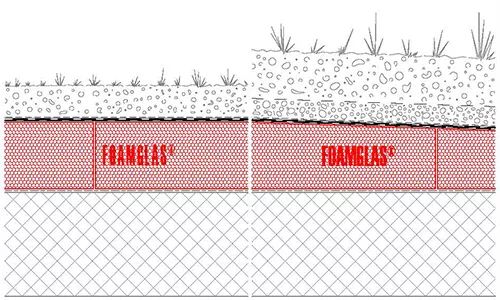
In this context, the compact roof system with FOAMGLAS® offers a sustainable solution. Thanks to its fully bonded, cavity-free structure, it is particularly well-suited to the extreme demands of a changing climate. The compact roof system impresses with its dimensional stability, compressive strength, water and vapor tightness, and consistent thermal insulation. It thus effectively protects the building structure from moisture, heat, and mechanical stress, even under intensive use or extreme weather conditions.
*Whether it’s a rooftop terrace or a high-traffic area, the compact, dimensionally stable roof structure offers reliable protection against thermal and mechanical stresses.
Shielded on the outside, protected on the inside
FOAMGLAS® cellular glass insulation plays a key role here: it consists of millions of hermetically sealed glass cells that make it completely impervious to water and vapor. This is a decisive advantage, particularly given the increasing frequency of extreme weather events. Even in cases where water accumulation is intended—such as with green roofs or retention roofs—FOAMGLAS® retains its shape over the long term and does not decompose. This insulation material thus guarantees consistent performance for over 100 years (certified according to EPD-PCE-20200300-IBB1-EN).
At the same time, its vapor impermeability prevents moisture from penetrating the building structure and contributes to the longevity of the entire roof. When outdoor temperatures are high, the material effectively protects against overheating. It mitigates the effects of extreme heat and thus helps create a pleasant indoor climate within the building.
Furthermore, FOAMGLAS® is non-combustible (Euroclass A1 according to European standard EN 13501-1) and thus meets the highest fire safety requirements. This represents an important safety factor, particularly when installing photovoltaic systems on flat roofs. Furthermore, the insulation material has high compressive strength, so that static loads—such as those from solar modules or substrate layers—are absorbed durably and without deformation. Combined with full-surface installation and tight joints, this results in a robust and watertight roof structure that withstands even high mechanical and thermal stresses over the long term.
WATERPROOF and well-designed
The compact roofing system combines these material properties with a well-designed layered structure. The cellular glass panels are bonded over the entire surface without any gaps, creating a homogeneous, pressure-resistant insulating layer. Thanks to this system, any water infiltration into the roof structure is prevented. Even in the event of heavy rain or mechanical damage to the waterproofing, functionality is maintained, as the insulation itself does not absorb moisture. Thus, any water infiltration can cause only limited damage. Furthermore, the damaged area can be located quickly and precisely. This is particularly advantageous for retention roofs, where water accumulates intentionally.
In comparison, flat roof insulation made from other materials often requires replacing a much larger section of the roof, as they absorb moisture and it is difficult to control the spread of damage. This makes the compact roof particularly resistant to weather damage, a key factor for the longevity of roofs in an era when extreme weather events are becoming increasingly frequent.
Flat roof with water tank
It is also possible to construct a water-retention roof based on the compact roof. The structure is supplemented with technical installations and/or a vegetation layer. This allows for the temporary storage of up to 160 liters of water per square meter and its controlled release. The FOAMGLAS® insulation layer located beneath thus remains permanently dry and functional, even during heavy rains and flooding. It thereby ensures the long-term stability and thermal insulation performance of the roof, while contributing to urban water management: stormwater systems are relieved, and the risk of flooding is significantly reduced.
The retention roof thus follows the principle of the sponge city, which aims to absorb rainwater where it falls and reintroduce it into the urban water cycle.
Multifunctional use
Green roofs improve the microclimate, trap fine particles, lower ambient temperatures, and promote biodiversity—all important factors in combating urban heat islands. Thanks to its high compressive strength and dimensional stability, the system easily withstands intensive use, such as on rooftop terraces, sports fields, or parking lots, without compromising insulation performance or durability.
In the face of growing challenges posed by climate change and extreme weather conditions, flat roof solutions with FOAMGLAS® provide a reliable foundation for climate-resilient cities. They create flexible, multifunctional surfaces that make urban spaces ready for the future. In this way, they make a decisive contribution to sustainable urban development and help ensure quality of life in urban areas over the long term.